
Optimal Site Location
How we pick the best places to deploy air quality sensors
Our site locator blends geospatial data, demographic insights, and constraint-aware optimization to surface monitoring spots that maximize coverage and impact. Every recommendation comes with the evidence behind it.
What makes a site optimal?
High coverage, strong signal on pollution sources, reliable access, and adherence to deployment rules. We balance these factors automatically so you deploy fewer sensors with better insight.
Inputs
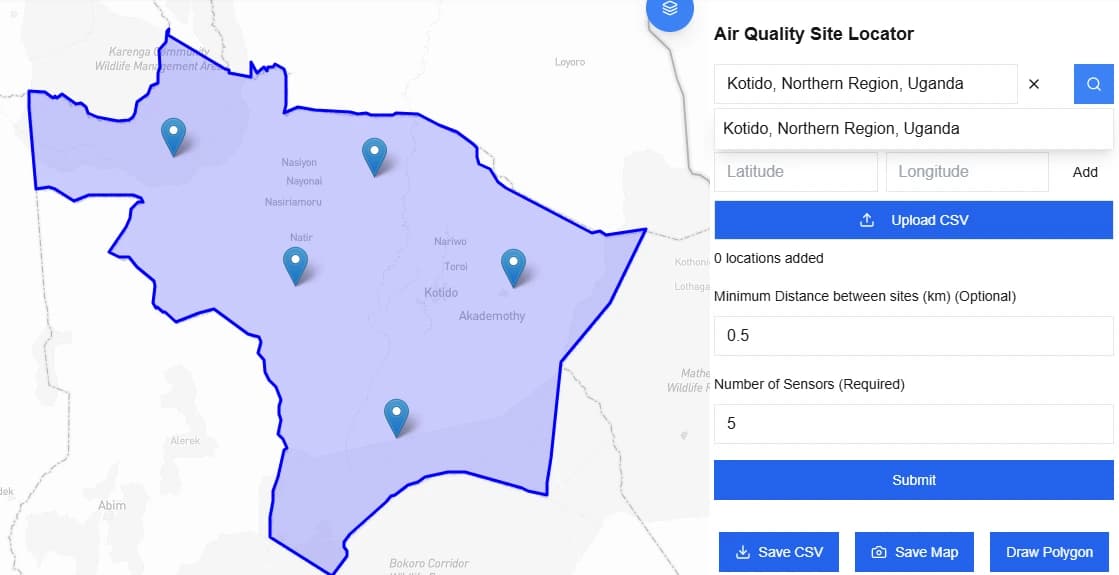
Boundaries or drawn polygons, number of sensors, minimum spacing, must-have points, and optional CSV uploads of important sites.
Outputs
Ranked coordinates with scores for population coverage, source proximity, and marginal gain.
Our approach
Multi-layer data
Blend population density, land use, pollution sources, terrain, and existing monitors for a full context of each candidate location.
Constraint-aware siting
Respect minimum spacing, must-have points, and geographic boundaries so recommendations are actionable in the field.
Exposure coverage
Prioritize areas with higher population or vulnerable groups while ensuring coverage of key emission hotspots.
Iterative optimization
Run simulations across thousands of candidates and keep the configuration that maximizes coverage with the fewest devices.
What you get
The tool translates complex geospatial analysis into a clear deployment plan. Each run is reproducible and can be tuned with new inputs at any time.
- Downloadable CSV with recommended coordinates, tagged by priority
- Interactive map to review, adjust, and lock must-have locations
- Clear rationale for each suggested site: population, source proximity, and coverage gain
- Ability to rerun scenarios with new constraints in seconds
Field-ready and transparent
We pair AI recommendations with the context teams need to validate sites on the ground: access hints, nearby infrastructure, and why each point was chosen.
Validation-friendly
Export results for offline review and sync updates when back online.
Continuous improvement
Rerun scenarios as new monitors come online or priorities shift.